

The intelligence layer for materials science.
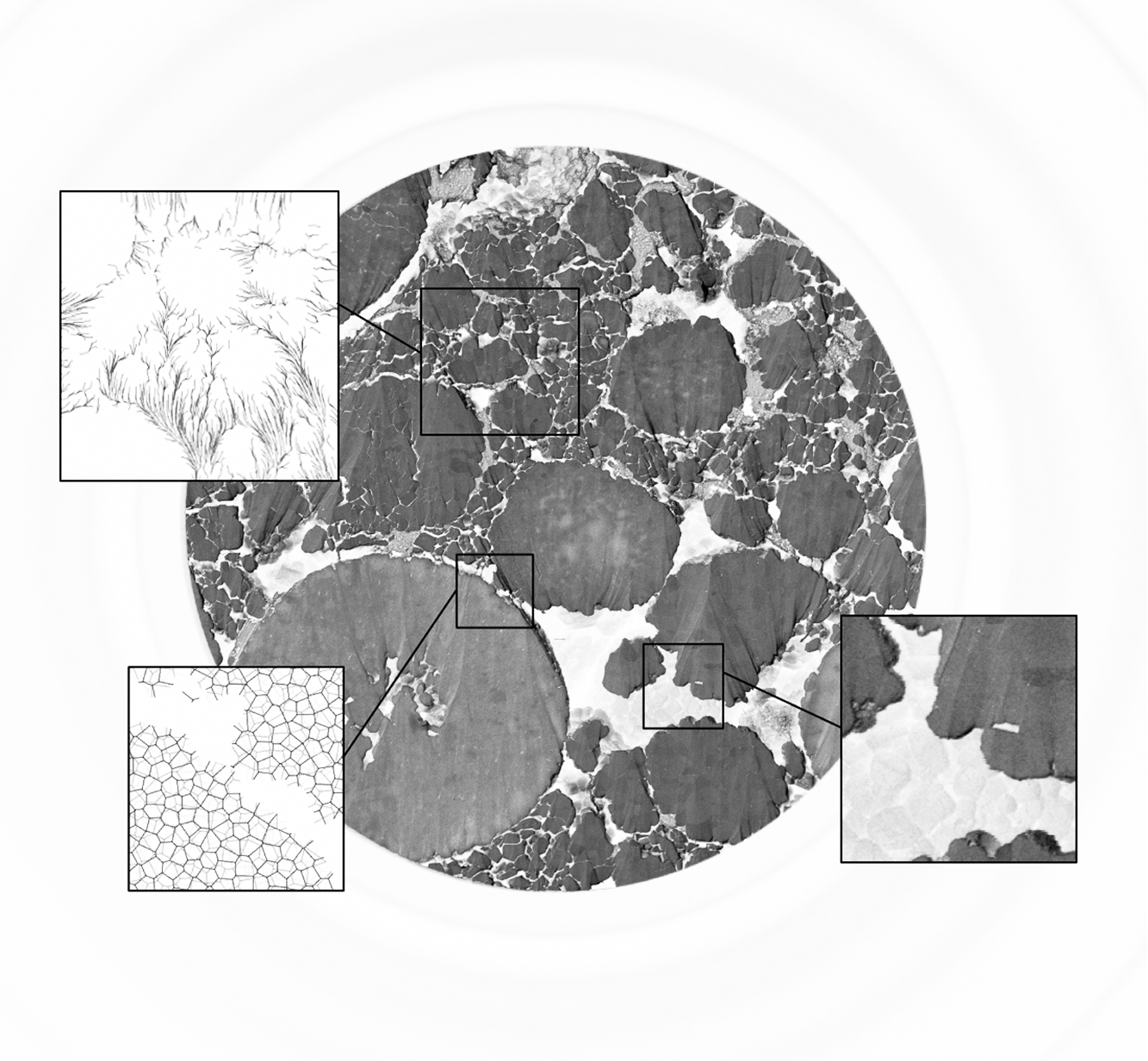
Microstructure dictates performance. Current workflows don’t capture it.
Microstructure dictates performance.
Performance, reliability, yield, and lifetime are all shaped by microstructure. This is why every lab in the world has microscopes.
But current workflows are not capturing it.
Teams already generate huge amounts of microstructural data. But most of that data is still interpreted manually, partially, or inconsistently.
This introduces risk and bottlenecks innovation.
Critical engineering decisions rely on incomplete insight, slowing development, increasing iteration cycles, and leaving performance on the table.
We build AI models to characterise and design microstructure better than ever before.
Purpose-built AI models for microstructure workflows.
Covering segmentation, quantitative analysis, 3D reconstruction, and design.
Characterisation at a new level of fidelity.
Automate the measurement of features, phases, and defects through Polaron Segmentation with accuracy that matches or exceeds expert analysis. Unlock 3D insights at the speed and resolution of 2D imaging through Polaron Reconstruction.
Move from observing microstructure to designing it.
Use microstructure as a controllable variable. Explore how process and material choices shift microstructure, and what that means for performance with Polaron Design - enabling faster, evidence-driven decisions at every stage.

Sign up for our newsletter
Sign up for our newsletter to receive our latest insights and featured content delivered straight to you.
Thank you! Your submission has been received!
Oops! Something went wrong while submitting the form.