


Microstructure-derived parameterisation for physics-based models.
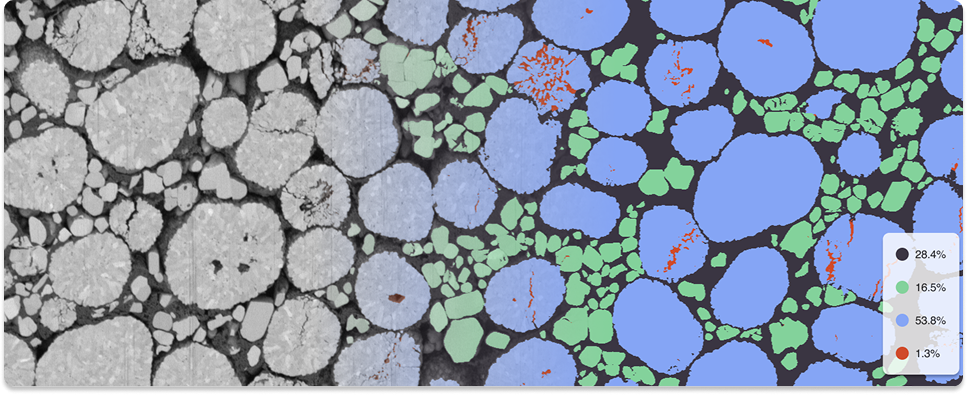
Derive modelling-ready descriptors from segmentation and reconstruction (e.g., phase fractions, transport properties, interfacial surface areas) to improve predictive power of models.
Reduced parameterisation burden via microstructure-grounded inputs.
Decrease reliance on ad-hoc fitting and complex, unclear experiments by grounding assumptions in repeatable, image based workflow. Supporting more defensible models and faster iteration when exploring process/material changes.
Predictive models for process, structure, performance.
Build predictive models that connect process conditions to microstructure and ultimately to performance outcomes - so teams can forecast how changes in processing are likely to shift structure and impact KPIs, and then prioritise the most valuable experiments to validate.
Read our latest case study here.
Polaron has been supporting leading automotive OEMs to quantify electrode level degradation.
Speak to Us
Working on similar problems? We can share relevant examples and discuss your workflow.
Thank you! Your submission has been received!
Oops! Something went wrong while submitting the form.