

Polaron automates quantification of cracks for more robust supplier qualification.
%201.png)
A battery cell's performance - including its energy density, fast-charge capability, and lifespan - is dictated by its electrode microstructure. Key factors include degradation (cracking, plating), transport (tortuosity, conductivity), and structural trade-offs like porosity. However, many OEMs lack the tools to extract this vital microstructural data, forcing them to rely heavily on suppliers and thereby increasing risk.
The Cost of Manual Analysis
To qualify supplier electrodes, OEMs conduct independent analyses using various experimental techniques, one of which is Scanning Electron Microscopy (SEM). It is important to identify intra-particle cracks, which increase internal resistance and are precursors to capacity fade. Yet, there is no universal industry standard for measuring this cracking. Alternative methods lack statistical significance or demand slow experimental workloads. Consequently, engineers are often left analysing SEM images manually. Extracting a statistically significant sample size can take weeks or months of engineering time, and because legacy software tools lack accuracy, the analysis often defaults to qualitative estimation using a handful of images.
Automating Characterisation
AI-native segmentation is the key to eliminating this bottleneck. In a recent deployment with a leading automotive OEM, we demonstrated how automating crack volume measurements can compress supplier qualification timelines by weeks. Using our proprietary deep learning models, the Polaron platform converts raw 2D images into defensible, quantitative data. The segmented image clearly distinguishes between inter-particle porosity (void space required for electrolyte wetting), intra-particle cracks (mechanical flaws from manufacturing or cycling), and active material (the primary phase undergoing lithiation).

Quantifiable Results
Working with the OEM to predict cracking across a cell's lifecycle, we benchmarked our AI models against expert human labelling. The results demonstrated major improvements in accuracy, stability, and scalability compared to existing processes (see Figure 2).
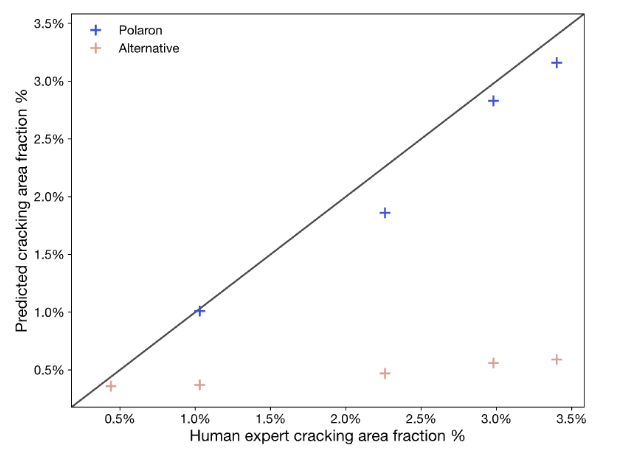
Crucially, our AI-driven methodology accelerated the time required per sample by more than 200x—reducing analysis time from 8 hours to under 5 minutes. This efficiency gain allowed weeks of manual work to be automated into hours, enabling our client to integrate crack quantification into routine, high-volume supplier qualification workflows.
Conclusion
As the automotive industry accelerates its transition to electrification, relying on manual, qualitative microstructural analysis is no longer viable. By codifying human expertise into repeatable, data-driven workflows, we are helping to transform a critical supply chain bottleneck into a strategic advantage. At Polaron, we believe that embracing automated characterisation is the key to empowering OEMs to bring safer, higher-performing batteries to market faster than the competition.